 AI-powered, Human-reviewed.



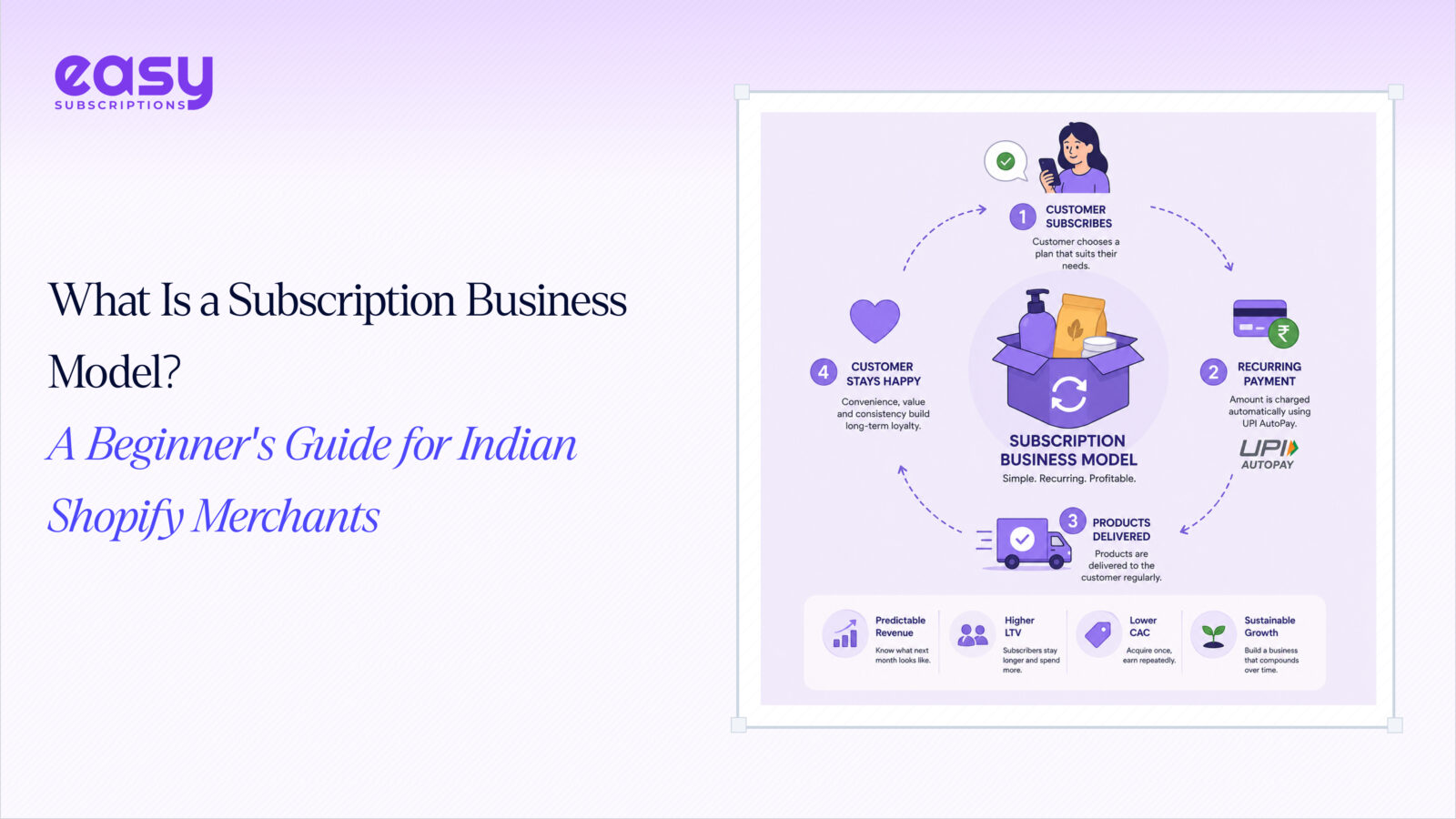


For Indian Shopify merchants facing rising ad costs and increasing customer acquisition challenges, subscriptions offer a way to generate predictable recurring revenue while improving customer retention.
What Is a Subscription Business Model?
A subscription business model is simple: customers pay a recurring fee at regular intervals; weekly, monthly, or yearly, in exchange for ongoing access to a product or service. They don’t need to place a new order each time. The charge happens automatically, and the product or service keeps arriving.
Compare that to a one-time purchase model, where every sale is a fresh transaction. You acquire the customer, they buy once, and then you have to win them back all over again. With a subscription-based model, you acquire them once and earn from them repeatedly.
That shift changes everything for a merchant.
Why it matters:
- Predictable revenue. You know, roughly, what next month looks like before it starts.
- Higher customer lifetime value (LTV). A subscriber who stays for 12 months is worth far more than a one-time buyer.
- Lower customer acquisition cost (CAC) over time. You spend money to acquire it once, not repeatedly.
The numbers back this up. The global subscription e-commerce market is valued at $3.08 trillion in 2026 and is projected to reach $9.05 trillion by 2034, growing at a CAGR of 14.40%, according to Fortune Business Insights. This isn’t a niche trend, it’s the direction commerce is moving.
Why Indian Merchants Are Adopting Subscriptions Now
A few years ago, recurring billing in India was genuinely painful. Customers didn’t trust auto-debits, and payment failures were common. That’s changed.
UPI AutoPay: NPCI’s recurring payments facility built on UPI rails, lets customers authorize a standing e-mandate once with their UPI PIN. Every subsequent charge happens automatically, without the customer needing to do anything. UPI processed 131 billion transactions in FY 2023–24, a 57% year-on-year jump, and AutoPay is a growing slice of that. The infrastructure is there.
Beyond payments, India’s D2C boom is creating the perfect conditions for subscription businesses. Beauty, wellness, food subscription, pet care, and baby products are all seeing strong subscription adoption. Think protein powder delivered monthly, a regional snack box arriving every four weeks, or a curated skincare set on a quarterly plan. These aren’t hypothetical, Indian brands are doing this right now.
Globally, the average subscriber spends $91 per month on subscription services, according to a CNET survey of 2,343 US adults (2024). Indian spending is lower, but the habit is forming fast especially among urban millennials and Gen Z buyers who are already comfortable with SIP-style auto-debits for their mutual funds.
For small Indian merchants managing tight inventory, the recurring revenue model is especially valuable. When you know 200 subscribers will reorder next month, you can plan procurement, packaging, and staffing with confidence.
The 3 Main Types of Subscription Business Models
Not all subscriptions work the same way. There are three distinct models, and picking the right one for your product is the most important decision you’ll make before launch.
1. Replenishment Subscriptions
What it is: Customers auto-reorder a consumable they use regularly. The product is the same every cycle, they’re not looking for discovery; they just want to never run out.
Best for: Groceries, supplements, protein powder, pet food, coffee, cooking oil, personal care staples, baby formula.
Indian angle: Daily-use products are a natural fit. Dal, ghee, protein powder, skincare essentials these are things customers buy every month anyway. A subscription just removes the friction of reordering.
Why it works: Replenishment subscriptions have the highest retention of the three types because they replace a habit. The customer doesn’t cancel; they just stop thinking about it.
2. Curation Subscriptions (Subscription Box Business Model)
What it is: A curated selection of products delivered on a schedule. The customer doesn’t choose what’s inside, that’s the point. Discovery and surprise are the products.
Best for: beauty boxes, snack boxes, book clubs, baby product samplers, artisan food, and regional specialty items.
Indian angle: There’s a growing market for discovery-based boxes, regional foods from across India, Ayurvedic skincare, and artisan coffee from Coorg or Araku. The subscription box business model works especially well as a gifting product, which is a strong use case in India.
Why it works: High perceived value. Customers feel like they’re getting more than they paid for, especially when the curation is strong. It also creates a strong gifting use case, people subscribe on behalf of others.
3. Access / Membership Subscriptions
What it is: Customers pay to unlock exclusive pricing, content, or perks. They’re not buying a specific product, they’re buying access to a tier.
Best for: Fashion, electronics, premium content, loyalty programs, wholesale-style pricing for repeat buyers.
Indian angle: Premium member pricing for repeat buyers is an underused model in Indian D2C. A ₹199/month membership that unlocks 15% off all orders and free shipping can dramatically improve retention without requiring complex logistics.
Why it works: Builds community and brand loyalty. Members feel invested in the brand, they’ve paid to be part of it.
Quick Comparison
| Type | Best For | Retention Driver | Indian Example Category |
| Replenishment | Consumables | Habit replacement | Groceries, supplements, pet food |
| Curation | Discovery | Surprise & delight | Beauty boxes, snack boxes |
| Access / Membership | Loyalty | Exclusive perks | Fashion, premium content |
Key Metrics Every Subscription Merchant Must Track
Running a subscription business without tracking these numbers is like driving without a dashboard. Here’s what actually matters.
MRR (Monthly Recurring Revenue) Your total predictable monthly revenue from active subscribers. If you have 300 subscribers paying ₹999/month, your MRR is ₹299,700. This is the number investors and lenders care about most.
Churn Rate: The percentage of subscribers who cancel their subscription during a specific month. For e-commerce subscriptions, Chargebee benchmarks average annual churn at 20–30% meaning a healthy business loses roughly 2–3 subscribers out of every 100 per month. Higher than that, and you have a retention problem worth fixing immediately.
Churn is the #1 metric to watch when you’re starting out. Acquiring new subscribers while losing existing ones at a high rate is like filling a leaky bucket. Fix the leak first.
LTV (Customer Lifetime Value) Total revenue from one customer over their full subscription life. If your average subscriber stays for 8 months at ₹999/month, their LTV is ₹7,992.
CAC (Customer Acquisition Cost) What you spend to acquire one subscriber ads, influencer fees, referral costs, all of it. The industry benchmark is a 3:1 LTV:CAC ratio. If your LTV is ₹7,992, your CAC should ideally stay below ₹2,664.
ARPU (Average Revenue Per User) Simple: MRR ÷ active subscribers. Tracks whether your revenue per subscriber is growing or shrinking over time.
How to Know If Your Product Is Subscription-Ready
Subscriptions can drive recurring revenue, but they aren’t right for every product. Start by answering these five questions.
- Do customers reorder this product regularly? If the answer is no, a subscription will feel forced.
- Is there a natural replenishment cycle? Weekly, monthly, quarterly, there should be a logical cadence.
- Would a discount incentivize commitment? Most subscribers expect a small price advantage over one-time buyers.
- Is the product consumable or experience-based? Consumables run out; experiences create anticipation. Both work.
- Can you fulfill consistently at scale? Subscriptions punish inconsistency. A missed delivery month kills trust fast.
Products that work well: Supplements, coffee, pet food, skincare, baby essentials, snacks, cooking staples, herbal teas.
Products that don’t work well: One-off purchases (a specific book, a custom piece of furniture), highly customized items that require individual decisions each cycle, or very high-ticket items with long decision cycles where customers need months between purchases.
How to Launch a Subscription on Shopify in India (Overview)
Here’s the practical sequence. None of these steps are complicated individually, the key is doing them in the right order.
Step 1: Choose your subscription type. Replenishment, curation, or access. Don’t try to combine all three on your first launch. Pick one, validate it, then expand.
Step 2: Pick your pricing model. A fixed recurring (same price every cycle) is the simplest to start. Tiered pricing (e.g., 1-month, 3-month, 6-month plans at different rates) can improve LTV once you have data. Usage-based billing is complex, skip it until you’re established.
Step 3: Set up a subscription-ready payment gateway. For Indian merchants, Razorpay and Cashfree both support UPI AutoPay mandates. Standard payment gateways won’t handle recurring billing correctly; you need one that can register and execute e-mandates. See: Best Payment Methods for Shopify Subscription Businesses in India for a detailed comparison.
Step 4: Install Easy subscriptions, a shopify subscription app that handles the full recurring billing stack, subscription plan creation, customer self-service portal, dunning management for failed payments, and retention tools, in one place. It’s built specifically for Shopify merchants and integrates with Indian payment gateways.
Step 5: Create your first subscription plan and test the mandate flow. Before you go live, run a full test: create a subscription, complete the UPI AutoPay mandate setup, and verify the first charge processes correctly. Don’t skip this. A broken mandate flow on launch day is a bad start.
Step 6: Launch and track MRR + churn from day one. Set up your dashboards before you have subscribers, not after. You want clean data from the first transaction.
Step 7: Connect with the Easy Subscriptions support team for subscription setup in India. Need help setting up your subscription business? Reach out to the Easy Subscriptions support team at support@easysubscription.io for guidance on subscription plan configuration, payment gateway setup, mandate testing, customer notifications, and retention settings. Whether you’re launching your first subscription or optimizing an existing program, the team can help ensure everything is configured correctly before you go live.
Common Mistakes Beginners Make
We see these same errors repeatedly. They’re all avoidable.
Pricing is too low. Subscriptions have real costs: fulfillment, packaging, payment processing fees, and the occasional failed payment. Price for the full cost, not just the product.
Skipping the customer portal. Subscribers need to be able to pause, skip, or cancel on their own. If they can’t, they’ll dispute the charge with their bank instead and chargebacks are expensive and damaging. According to Recurly’s 2026 State of Subscriptions report, merchants offering a “pause before cancel” option saw pause usage jump 337% year over year, and 3 out of 4 subscribers who pause eventually return.
Not setting up dunning management. When a UPI mandate fails and it will, eventually you need an automated retry sequence. Silent churn from failed payments is the most preventable kind of churn there is.
Launching without testing the UPI AutoPay mandate flow. The mandate setup experience is unfamiliar to many Indian customers. Test it yourself, then have a friend test it. Fix any friction before you send traffic.
Treating the subscription like a one-time product listing. A subscription needs its own landing page, its own messaging (emphasizing convenience, savings, and never running out), and its own retention strategy. It’s a different product category, not just a variant.